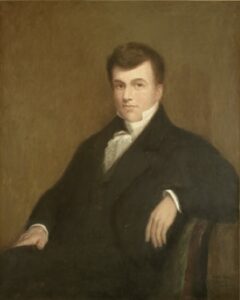
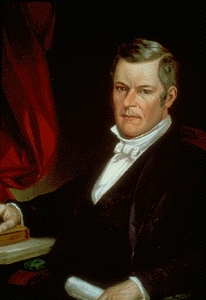
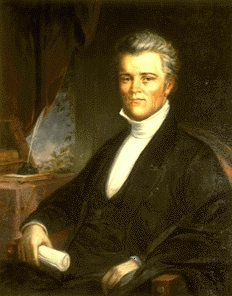
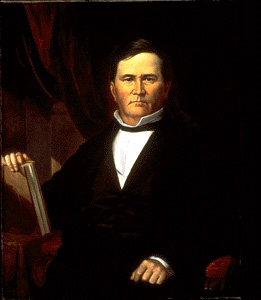
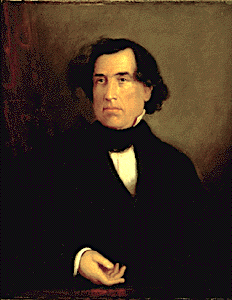
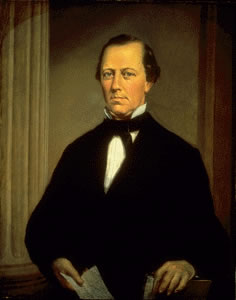
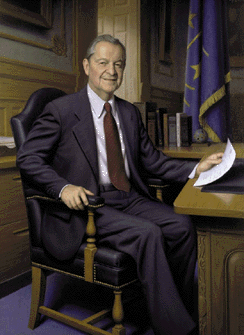
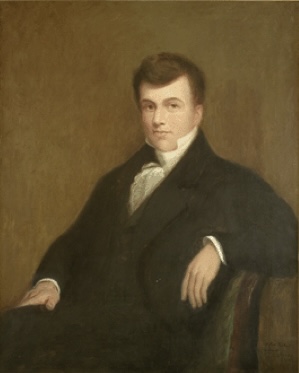
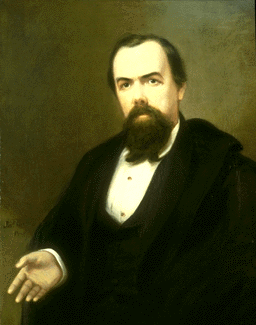
There’s little question that Freemasonry left a profound imprint on Indiana politics from the territorial era through the 21st century. First established in the Indiana Territory at Vincennes by 1807, the fraternity grew rapidly and became a key network for the state’s earliest leaders. The Grand Lodge of Indiana formed in January 1818, just over a year after statehood was achieved in December 1816. It had been proposed at the very first meeting of the state’s new General Assembly by an enthusiastic group of legislators. Freemason Jonathan Jennings was elected governor in 1816, handily defeating the incumbent territorial governor at the time, Freemason Thomas Posey. And Jennings’ Lieutenant Governor, Christopher Harrison, was also a Freemason. In fact, five of the state’s first eight governors were Freemasons: Jonathan Jennings, James B. Ray, Noah Noble, David Wallace, and James Whitcomb.
Masonic lodges often doubled as community hubs for education, libraries, and public meetings on the frontier, spreading democratic ideals, moral values, and civic engagement. The Grand Lodge’s first two headquarters in Indianapolis were deliberately located across the street from the State House, and our two annual meetings were held on dates to correspond with the meetings of the General Assembly.
Countless territorial officials, legislators, judges, and governors were Masons, shaping Indiana’s foundational institutions.These men balanced public service with lodge life, often rising to high Masonic office while shaping Indiana’s government, infrastructure, education, and social policy. Their stories reveal a remarkable pattern: many came from modest beginnings, built careers through law or business, served in the military, and found in Masonry both fellowship and a platform for civic duty.
At least 24 governors have had documented lodge affiliations, spanning from statehood to 2003. These men were not a monolithic bloc—Indiana politics featured vigorous partisan divides—but their shared Masonic bonds fostered personal networks, a commitment to public service, and principles like liberty, equality, and charity that influenced policy.
Regardless of their widely differing political affiliations, these 24 Masonic governors embodied Indiana’s pioneer spirit, patriotism, and progressive governance. Their lodge affiliations—often in small-town lodges—anchored them to the smallest of communities even as they shaped the state’s character that prevails today. Masonry provided a common bond of moral purpose and public service that helped forge modern Indiana. Their collective legacy remains a proud chapter in both Hoosier and Masonic history.
Name
Term of Office
Gov. Number
Description
1. Jonathan Jennings
1816-1822
1st
(b.March 27, 1784 – d. July 26, 1834)
The first elected governor and fifth Grand Master of Masons in Indiana, Jonathan Jennings was raised in Pisgah Lodge No. 45, Corydon (1817) under a Kentucky charter; he later affiliated with Blazing Star Lodge No. 3, Charlestown. While governor he served as lodge Master, Senior Grand Warden, Deputy Grand Master, and ultimately Grand Master (1823-24). He led Indiana into the Union, moved the capital to Corydon, and fiercely opposed slavery.
His Lieutenant Governor, Christopher Harrison, was also a Freemason and a founder of the Grand Lodge of Indiana.
2. James B. Ray
1825-1831
3rd
(b. February 19, 1794 – d. August 4, 1848)
A colorful “Brookville Triumvirate” member, James B. Ray was made a Mason in Harmony Lodge No. 11, Brookville (1819) and served briefly as Secretary before demitting in 1825 while acting governor. He championed roads, education, and penal reform; his eccentric style and treaty work with the Miami and Pottawatomie tribes marked a memorable administration.
3. Noah Noble
1831-1837
4th
(b. January 15, 1794 – d. February 8, 1844)
Also of the Brookville Triumvirate, Noah Noble was the first petitioner to Harmony Lodge No. 11 under Ohio dispensation (1817). He served as Treasurer, Junior Warden, and Master, then affiliated with Centre Lodge No. 23, Indianapolis. As governor he created the second State Bank of Indiana and earned a reputation for hospitality and sound administration.
4. David Wallace
1837-1840
6th
(b. April 24, 1799 – d. September 4, 1859)
Father of Ben Hur author General Lew Wallace, David Wallace completed the Triumvirate in Harmony Lodge No. 11, Brookville (quickly raised 1826 under “case of emergency”). He was Junior Warden and a gifted orator who delivered the Feast of St. John the Baptist address. His term saw the last tribal relocation of Indians to Kansas and the first Thanksgiving proclamation; internal infrastructure improvements later cost him re-election because of a national financial crisis.
His Masonic apron was later worn by his son Lew when he joined a lodge many years later and is on loan to the Library Museum from the Lew Wallace Study & Museum in Crawfordsville.
5. James Whitcomb
1843-1848
8th
(b.December 1, 1795 – d. October 4, 1852)
A self-made New Englander, James Whitcomb received degrees likely in Kentucky before becoming charter Senior Warden and twice Master of Bloomington (later Monroe) Lodge No. 22. He was Grand Orator (1825), honorary member of Marion Lodge No. 35, and the first man knighted in Raper Commandery No. 1 of the Knights Templar (which was organized in his home). He rescued the state’s credit, organized troops for the Mexican War, and advanced public schools.
6. Ashbel P. Willard
1857-1860
11th
(b. October 31, 1820 – d. October 4, 1860)
The first governor to die in office, Ashbel P. Willard was raised in Jefferson Lodge No. 104, New Albany (1850) and demitted in 1856. A brilliant orator and defender of his brother-in-law in the John Brown raid, he strongly defended state’s rights in the years preceding the Civil War. His premature death left the state’s Democratic party in disarray.
7.Abram A. Hammond
1860-1861
12th
(b. March 21, 1814 – d. August 27, 1874)
Lieutenant governor who succeeded Willard for three months, Abram A. Hammond was made a Mason in Centre Lodge No. 23, Indianapolis (1852) and demitted the following year. A respected lawyer, he sought a peaceful solution to the slavery issue and preservation of the Union. He recommended the safeguarding of ballot boxes during elections and a state ‘home of refuge’ for juveniles.
8. Oliver P. Morton
1861-1867
13th
(b. August 4, 1823 – d. November 1, 1877)
Indiana’s great Civil War governor and first native Hoosier in the office, Oliver P. Morton received the Entered Apprentice degree in Hiram Lodge No. 42, Centerville (1854). Remaining degrees were never conferred amid lodge controversy over what appeared to be a personal feud. His patriotic leadership in vehement defense of the Union earned national acclaim. Known for famously locking the General Assembly out of the Statehouse for two tumultuous years, he later served as U.S. Senator and was considered by President Grant for Supreme Court nomination.
9. Ira J. Chase
1891-1893
22nd
(b. December 7, 1834 – d. May 11, 1895)
Civil War veteran and Disciples of Christ minister, Ira J. Chase was raised in Palatine Lodge No. 314, Illinois (1860), later affiliated with Excelsior Lodge No. 41, LaPorte, and finally Mystic Tie Lodge No. 398, Indianapolis. A founding officer and commander of the Grand Army of the Republic, he became acting governor upon Gov. Alvin P. Hovey’s death in 1891. He expanded the state’s road system, began construction of the state’s Soldiers’ and Sailors’ monument, and urged the passage of alcohol prohibition laws.
10. Winfield T. Durbin
1901-1905
25th
(b. May 4, 1847 – d. December 18, 1928)
Winfield T. Durbin was raised in Ancient Landmarks Lodge No. 319, Indianapolis (1871) and affiliated with Mt. Moriah Lodge No. 77, Anderson (1885). He belonged to Anderson Chapter and Commandery; served as Grand Commander of Knights Templar (1896); and was crowned a 33° Scottish Rite Mason. A veteran of two wars, he suppressed violent ‘white cap’ vigilante group lynch mobs; he advocated a state highway system, anti-trust protections for the public, stiff fines for vote buyers, and the creation of juvenile courts.
11. J. Frank Hanly
1905-1909
26th
(b. April 4, 1863 – d. August 1, 1920)
A prohibition crusader and founder of “Hanly’s Flying Squadron” temperance league, J. Frank Hanly was raised in Hedrick Lodge No. 465 (1888) and later affiliated with Tippecanoe Lodge No. 492, Lafayette (demitted 1908). His landslide victory funded the Indiana Girls’ School and county local-option liquor law; he banned gambling in Indiana, reformed the state’s accounting methods and prosecuted members of his own administration for corruption; he later made a failed run for president on the Prohibition ticket.
12. Thomas R. Marshall
1909-1913
27th
(b. March 14, 1854 – d. June 1, 1925)
Vice president to Woodrow Wilson and beloved Hoosier philosopher, Thomas R. Marshall was raised in Columbia City Lodge No. 189 (1881) and served as Master (1902-03). He was Grand Master of the Grand Council R.&S.M., Grand High Priest of the Grand Chapter R.A.M., and an Active 33° Scottish Rite member. His administration advanced vocational education and inheritance tax.
13. Samuel M. Ralston
1913-1917
28th
(b. December 1, 1857 – d. October 14, 1925)
Another self-made Horatio Alger figure, Samuel M. Ralston was raised in Owen Lodge No. 273, Quincy (1881) and became a charter member of the reorganized Owen Lodge No. 655. His term established the Public Service Commission, workmen’s compensation, and steps toward Indiana’s state park system.
14. James P. Goodrich
1917-1921
29th
(b. February 18, 1864 – d. August 15, 1940)
World War I governor, James P. Goodrich was raised in Winchester Lodge No. 56 (1892) and became a charter member of Summers Lodge No. 638. He created the State Highway Commission and Department of Conservation and called the special session ratifying women’s suffrage.
15. Warren T. McCray
1921-1924
30th
(b. February 4, 1865 – d. December 19, 1938)
A successful businessman and cattleman, Warren T. McCray was raised in Newton Lodge No. 361 (1917; membership terminated 1925). Opposed growing political power of Indiana’s Ku Klux Klan and was falsely accused of embezzlement. The Klan then engineered a federal case against him for mail fraud; he served three years in prison and was pardoned by President Herbert Hoover. As governor, he sponsored school improvements, child-labor laws, and a two-cent gasoline tax for roads; his administration first occupied the Governor’s mansion.
16. Emmett F. Branch
1924-1925
31st
(b.May 16, 1874 – d. February 23, 1932)
Quiet successor to McCray, Emmett F. Branch was raised in Martinsville Lodge No. 74 (1897) and served as Master (1902-03). A Spanish-American and World War I veteran, he chaired the Grand Lodge Committee on Charters and Dispensations and later served as Grand Representative for Western Australia.
17. Edward L. Jackson
1925-1929
32nd
(b. December 27, 1873 – d. November 18, 1954)
Ed Jackson was raised in New Castle Lodge No. 91 (1902; membership terminated 1934). Despite Depression-era economy measures and his acquittal in a controversial Ku Klux Klan-related trial involving Grand Dragon D.C. Stephenson, Jackson reduced state debt and advanced conservation and the George Rogers Clark Memorial.
18. Harry G. Leslie
1929-1933
33rd
Athletic hero nicknamed “Skillet,” Harry G. Leslie was raised in Lafayette Lodge No. 123 and crowned a Scottish Rite 33° in 1931. He guided Indiana through the Great Depression, focusing on charitable institutions and penal reform.
19. Paul V. McNutt
1933-1937
34th
Extraordinary leader, educator, and later U.S. Ambassador to the Philippines, Paul V. McNutt was raised in Martinsville Lodge No. 74 (1912). As governor he reorganized 169 agencies into eight, enacted the gross income tax, and secured social-security participation. Had presidential aspirations but was blocked by Franklin Roosevelt’s unprecedented four terms in office. Briefly served as CEO of United Artists motion picture studios.
20. Ralph F. Gates
1945-1949
37th
Post-World War II governor, Ralph F. Gates was raised in Columbia City Lodge No. 189 (1935). He expanded the state’s mental-health facilities, created the Department of Commerce, and advanced flood-control projects.
21. George N. Craig
1953-1957
39th
First World War II veteran governor, George N. Craig was raised in Centennial Lodge No. 541, Brazil (1946). He reorganized the penal system, launched the toll-road program, and built a psychiatric research center.
22. Harold W. Handley
1957-1961
40th
Harold W. Handley was raised in Excelsior Lodge No. 41, LaPorte (1952). Facing fiscal shortfalls, he raised taxes, built the State Office Building, and accelerated highway construction while planning a Lake Michigan seaport.
23. Roger D. Branigin
1965-1969
42nd
Member of Franklin Lodge 107; son of former PGM Elba L.Branigin. Served as Governor during Grand Lodge’s 150th anniversary (his father had been GM for its 100th anniversary in 1918). He upgraded the state prison, highway and parks systems, strengthened the civil rights commission, repealed the personal property tax and the poll tax, and constructed the Port of Indiana, the state’s first deep-water harbor on Lake Michigan.
24. Frank O’Bannon
1997-2003
47th
Raised in Pisgah Lodge No. 32. Served 18 years in the State Senate. He expanded the development of the ethanol industry, established the state’s first community college system, championed early-childhood programs and charter schools, and created Indiana’s Amber Alert system.